
The Two Guadalupes
Mother-daughter Black Madonnas in Spain and Mexico.

Hello lovely readers and welcome to Idiot Parade.
After approximately 100 years (six months), I’m back with a new entry in my series on the Virgin of Guadalupe, the 16th century Marian apparition central to Mexican Catholicism and culture. If you’re here from a Bandcamp recommendation, hello! I promise you have not been swindled into following a tradcath Substack. My Guadalupe series is primarily concerned with the aesthetic and historical elements of the apparition, and wholly unconcerned with conversion. (We have an American Pope for that now. He likes baseball. Maybe you’ve heard?)
This series is paywalled because it’s time-consuming and somewhat expensive to produce, and because my paying subscribers care about it enough to make it possible. You can find previous entries here, here, and here. I recommend reading them in order. Everything else I write here is free.
Other than that, it’s nice to be back. Happy new year!
The conquistador Hernán Cortés was born in 1485 in Medellín, a village of marginal geographic and economic importance in the Extremadura region of Spain. It is now known primarily for being the birthplace of Hernán Cortés.
Over the course of the Spanish conquest of the Americas, Cortés and a large crop of Extremadura’s native sons would make the region famous for breeding conquistadors. These included Vasco Núñez de Balboa, the first European to discover the Pacific Ocean upon crossing Panama in 1513; Pedro de Alvarado, Cortés’ second-in-command in Mexico and conqueror of El Salvador and Guatemala; and the Pizarro brothers, who in 1533 subjugated the Inca Empire and, by extension, Peru. As Extremadurans, these men were necessarily aware of and often devoted to a supposedly miraculous Black Madonna housed at a monastery roughly 30 miles east of Trujillo. This would prove enormously consequential to the conversion of Latin America.
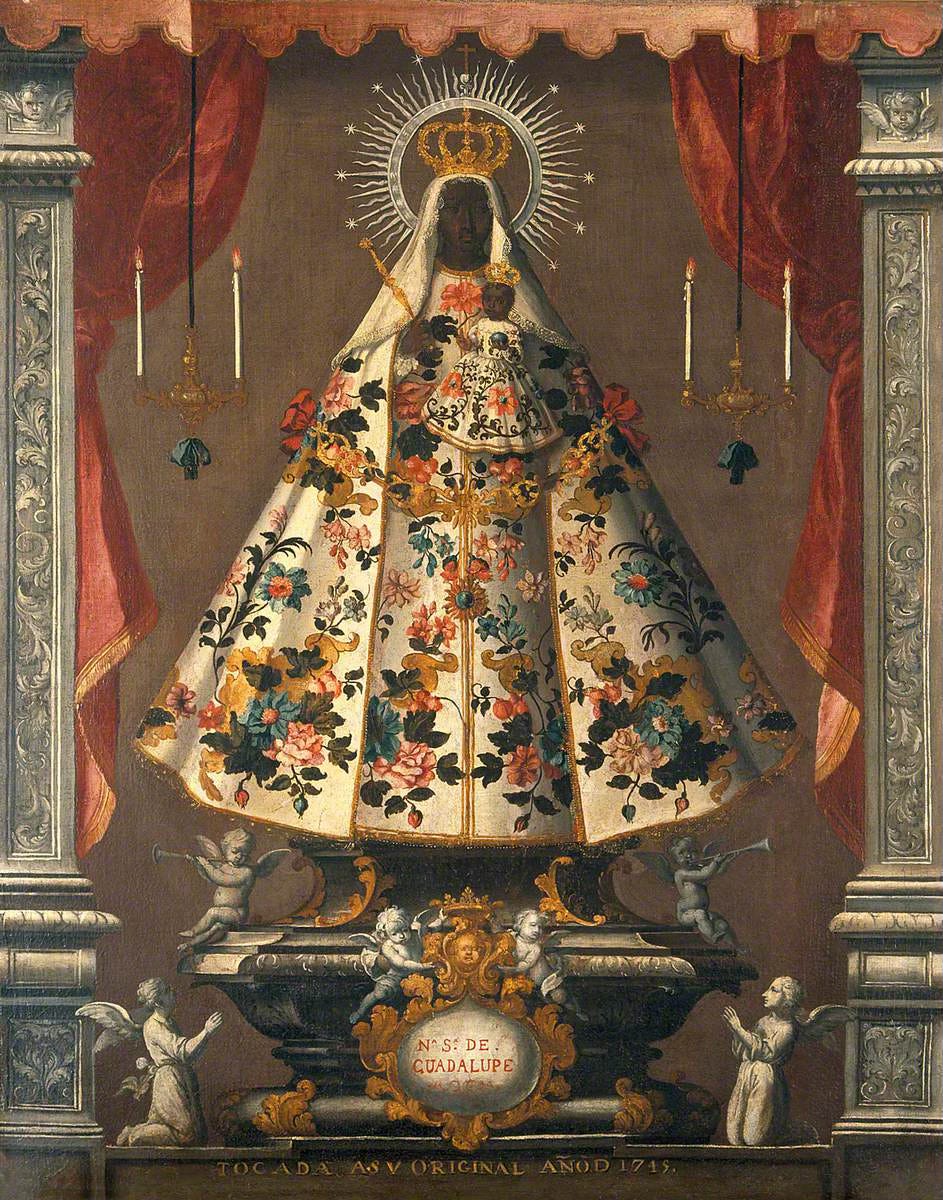
This Black Madonna, referred to as Our Lady of Guadalupe in Extremadura, is a cedar Madonna and Child statuette about two feet high. It is the central artifact of the most archeologically-minded Marian apparition in Catholic theology.
According to the legend, the Virgin Mary appeared to a poor Spanish rancher named Gil Cordero near the Guadalupe River after he carved a cross into the hide of a dead cow. She told him that a statue of her was buried nearby and instructed him to send for priests to excavate it and build a shrine on the site. She then resurrected his dead cow.
Upon returning to his village, Cordero found his son dead and prayed for the Virgin’s intercession. She obliged, and his son sprung back to life in front of the priests gathered for last rites. Cordero then took the priests to the riverbank where the Virgin had appeared. The priests excavated the statuette and—in a true archaeological miracle—its provenance papers.1 The papers credited Luke the Evangelist as the sculptor, and claimed the statuette arrived in Spain at the end of the 6th century as a gift from Pope Gregory I to the Archbishop of Seville.2 During the fall of Seville to the Moors in 712 AD, Franciscan monks fleeing the city buried it along the river for safekeeping.
Dates vary, but most accounts place the Cordero apparition auspiciously between the late 1200s and early 1300s. In context, the statuette’s miraculous rediscovery became a symbolic victory, crowning a century of Catholic military successes—Andalusia in 1212, Cordoba in 1236, and Seville in 1248—that limited Muslim rule in Iberia to the Emirate of Granada. In January 1492, the Spanish Catholic Monarchs Isabella and Ferdinand celebrated the capture of Granada with a grateful pilgrimage to the shrine. The statuette was henceforth known as La Victoriosa.
The Catholic Monarchs wouldn’t be the only notable pilgrims. Cortés, Christopher Columbus, and Francisco Pizarro all paid homage during their lifetimes.3 With the Reconquista completed, a new generation of ambitious Extremaduran conquistadors co-opted La Victoriosa with the goal of extending her winning streak overseas. Her armor-clad devotees claimed her as symbolic patron, and Guadalupe in Extremadura was declared Reina de la Hispanidad, Queen of [rapidly expanding] Hispanicity.
